
Trade courses in South Australia: occupations, skills and visa pathways
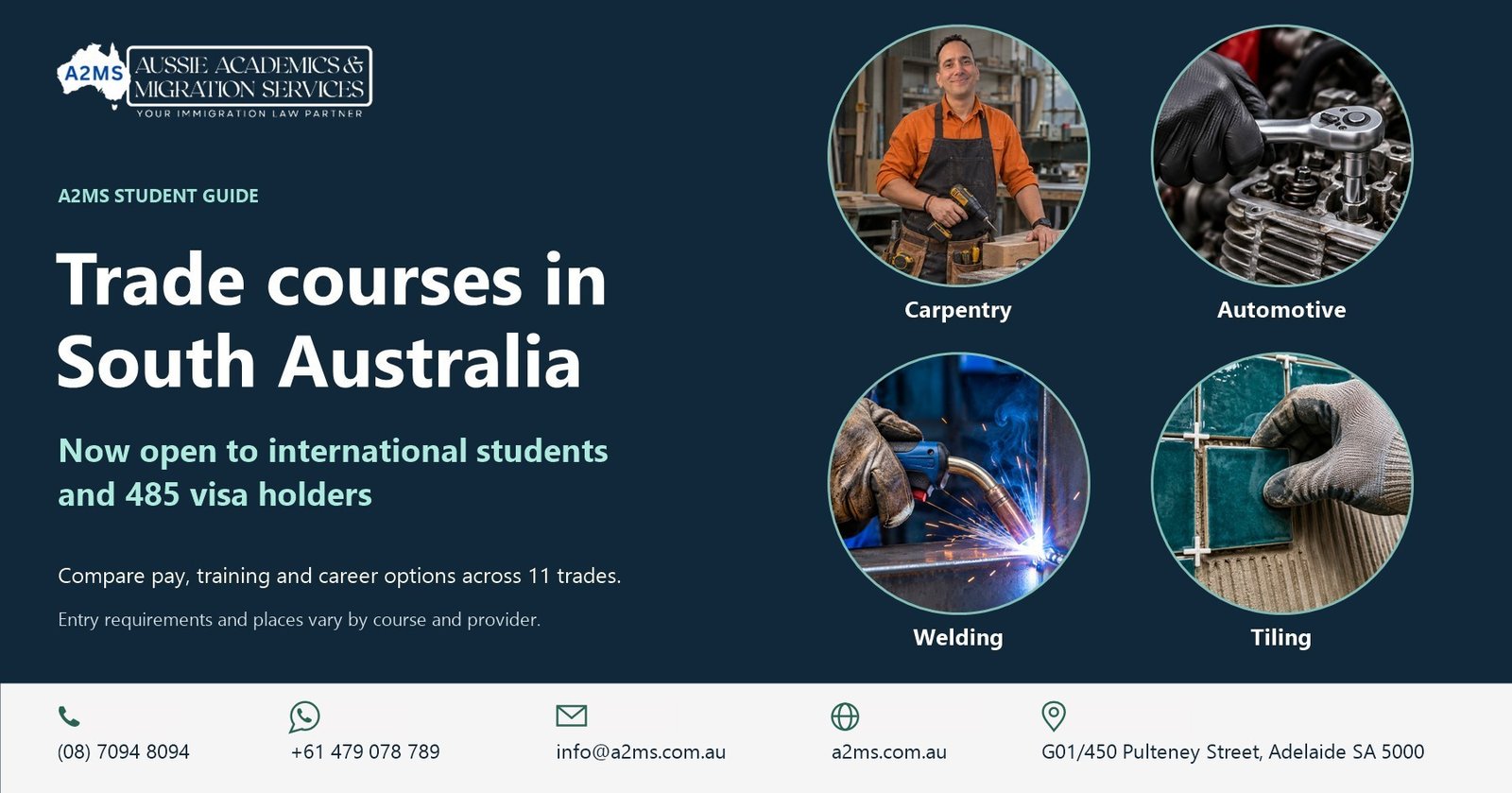
Can I enrol in a trade course in South Australia now?
Yes, new enrolments can go ahead for classroom and workshop-based training in declared trades. The South Australian Skills Commission says it will take no enforcement action under section 45A against registered providers delivering this training outside an approved training contract. Its position covers new and continuing students. Read the Commission’s enforcement update.
If you put your plans on hold, Manmeet can help you check whether your preferred course and campus are registered for international students, whether the provider is accepting applications, and how you’ll get practical experience before you pay a deposit.
Building a roof, tracing a wiring fault and repairing a diesel engine all require hands-on training. The tools, the workplace and the route to qualified work are different. Explore eleven trades in South Australia, then compare courses with an A2MS education consultant.
Choosing a course? Manmeet Chhabra, A2MS Principal Education Consultant, can help you compare trade qualifications, understand workshop and placement requirements, and prepare your admissions application.
Book a free 10-minute course call with Manmeet
Choosing a course with a visa goal in mind? Sunil Choudhary, Registered Migration Agent (MARN 2418425), can assess how your previous study, work experience and current visa affect your options. Book personal migration advice with Sunil (45 minutes, A$250).
Compare pay and job growth · Explore the trades · See industry demand · Compare visa data · Get help with admissions
Unsure which trade to choose? Start with two.
If you like solving faults, compare electrical and refrigeration. Electricians had national median weekly earnings of $2,191 and refrigeration mechanics $2,100. The difference is $91 a week. A better question for your shortlist is whether you want to work on wiring and circuits or cooling systems and cold rooms. Ask how you would secure the employer, supervised practice and registration your preferred route requires.
If you want to build things, compare carpentry and metal fabrication. Picture yourself setting out a timber roof frame, then measuring and assembling a steel staircase. Which would you want to do repeatedly, even if invitation scores changed? In October 2026 the national 189 minimum was 65 for carpenter and 80 for metal fabricator. Both feature in SA’s construction or manufacturing outlook. Neither score predicts the round after you graduate.
Are employers short of these skills?
Jobs and Skills Australia’s 2026 national list rated all eleven occupations in this guide as in shortage. That includes both light and diesel mechanics, tilers, welders and refrigeration mechanics. In South Australia specifically, the state’s construction outlook records shortages since 2021 for the groups covering carpenters and joiners, electricians, plumbers, painters, and structural steel and welding workers. For the other trades, the national rating alone cannot tell you how easy it will be to find supervised work near your home. 2026 shortage list · SA occupation outlook.
Could this lead to an invitation and permanent residence?
For a prospective student the first question is whether you can qualify and get the relevant work experience. Next, check how you could obtain a skills assessment and which points you could document. The 189 and 190 are permanent visas. The 491 is provisional, with a possible later 191 application if you meet its requirements. The figures below show what happened to earlier candidates. They cannot establish a personal invitation probability several years ahead.
Bring two trades to your first A2MS call. Tell Manmeet what you have studied or worked in, where you can travel for practical training, your budget and the kind of job you want. Ask her to help you narrow that to a course shortlist and identify what you need to check before paying. If your decision depends on a particular visa outcome, Sunil can assess that separately in a migration consultation. See how to get help with your shortlist.
What do tradespeople earn, and how many people work in each trade?
Across Australia, electricians had median full-time earnings of $2,191 a week, compared with $1,760 for carpenters and joiners. Electrical employment also grew by 7,200 people in a year. Select a trade below to compare its pay, workforce and day-to-day work.
Carpentry and joinery · $1,760 a week
Australian workforce 149,600 people · Annual change +2,900 people · Annual pay equivalent $91,520
Would you enjoy setting out timber frames on site, or building and fitting components in a workshop? Ask to see a drawing and a finished project from each option. Jobs and Skills Australia occupation profile.
Bricklaying and stonemasonry · $2,317 a week
Australian workforce 25,800 people · Annual change −800 people · Annual pay equivalent $120,484
A relatively high median comes from a much smaller workforce than carpentry. Try a practical session setting a corner to line and level before deciding whether this work suits you. Jobs and Skills Australia occupation profile.
Wall and floor tiling · pay estimate unavailable
Australian workforce 21,800 people · Annual change +500 people. Jobs and Skills Australia does not publish a reliable weekly pay figure for this group.
A bathroom combines layout, surface preparation and precise cuts around fixtures. When comparing courses, ask how often you complete a whole installation and receive feedback on the finish. Jobs and Skills Australia occupation profile.
Painting trades · $1,379 a week
Australian workforce 50,000 people · Annual change −2,300 people · Annual pay equivalent $71,708
SA identifies strong future demand for painters even though national employment fell over this year. Compare local residential repainting and commercial maintenance opportunities where you can travel. Jobs and Skills Australia occupation profile.
Plumbing · $1,990 a week
Australian workforce 107,600 people · Annual change +4,500 people · Annual pay equivalent $103,480
Would you prefer installing pipework on new builds or tracing leaks in occupied buildings? Ask how the training route leads to supervised work and registration in SA. Jobs and Skills Australia occupation profile.
Electrical · $2,191 a week
Australian workforce 197,300 people · Annual change +7,200 people · Annual pay equivalent $113,932
This is the largest national workforce among the trades shown here. Compare a domestic installation with an industrial fault-finding task, then check the employer and supervision requirements for the route you prefer. Jobs and Skills Australia occupation profile.
Air conditioning and refrigeration · $2,100 a week
Australian workforce 29,700 people · Annual change −400 people · Annual pay equivalent $109,200
Picture a supermarket cold room warming up overnight. Finding the fault involves pressure, temperature and electrical checks. Ask which systems you will diagnose in a workshop. Jobs and Skills Australia occupation profile.
Structural steel and welding · $1,688 a week
Australian workforce 79,100 people · Annual change +1,100 people · Annual pay equivalent $87,776
Making a steel staircase involves reading a drawing, cutting material, assembling sections and welding joints. Ask which of those tasks dominates the job you want. The figures cover fabrication and welding together. Jobs and Skills Australia occupation profile.
Motor mechanics · $1,622 a week
Australian workforce 112,600 people · Annual change +1,800 people · Annual pay equivalent $84,344
A suburban workshop diagnosing a passenger car and a regional workshop servicing diesel trucks use different equipment. Ask what vehicles you will work on, how much diagnostic practice you get and where placements usually take place. The figures cover the wider mechanic group. Jobs and Skills Australia occupation profile.
Figures are national occupation-group estimates. Employment and the change over the preceding year are from February 2026. Pay is the May 2025 median before tax for full-time, non-managerial employees on adult rates. Half earned more and half earned less. Annual equivalents use 52 weeks at that rate. Apprentice pay, individual offers and self-employed income can differ.
Explore the work before choosing a course
Building and finishing
Carpentry, bricklaying, tiling and painting
A carpenter sets out timber frames and roof structures. A bricklayer builds walls to line and level. A tiler prepares surfaces, cuts tiles and sets out patterns. A painter prepares and protects surfaces and applies finishes. If you enjoy working outdoors on a structure, compare carpentry and bricklaying. If you prefer detail and an accurate finish, compare tiling and painting.
Compare Certificate III studies in Carpentry (CPC30220), Bricklaying and Blocklaying (CPC33020), Wall and Floor Tiling (CPC31320) or Painting and Decorating. Ask to see a typical workshop project and the list of tools you must buy.
Building services
Plumbing, electrical and refrigeration
A plumber installs and tests water and drainage systems. An electrician installs circuits and traces faults. A refrigeration mechanic diagnoses cooling systems and services equipment in buildings, supermarkets and cold stores. These roles suit people who like fault-finding, measurements and safety procedures.
Ask whether you need an employer and a training contract before you start. For electrical and plumbing work in SA, check the registration category, supervised work and evidence required. SA trade registration requirements.
Engineering workshops
Metal fabrication and welding
A fabricator reads drawings, cuts plate or sections and assembles components. A first-class welder specialises in joining metal to a specification. A workshop making a steel staircase may use both skills. Think about whether you enjoy building the whole assembly or perfecting a joint.
Ask which drawings, machines, materials and welding processes you will use. If you have worked overseas, bring a description of your duties so we can compare your experience with the proposed training.
Automotive workshops
Light vehicle and diesel mechanics
A general motor mechanic diagnoses faults and repairs vehicles in a workshop. Diesel work can involve trucks, heavy vehicles or machinery. The vehicle and systems you want to work on should guide the qualification you compare.
Compare light vehicle mechanical technology (AUR30620) with heavy commercial vehicle mechanical technology (AUR31120). Ask about diagnostic equipment, access to vehicles and supervised workshop practice. Motor Trade Association career pathways.
Where South Australian industry expects demand
Housing and infrastructure. Construction employed 87,900 South Australians in February 2026. In 2024–25 the sector added $11.75 billion to the SA economy, up 5% on the previous year. Nearly 92% of the state’s construction businesses employ four people or fewer. When comparing placements, ask who will supervise you in a small crew and which jobs you can practise. SA Construction Workforce Plan. The state’s 2026 outlook rates future demand as strong for carpenters and joiners, painters, plumbers and electricians. New homes need framing and finishing crews, while hospitals and transport projects also draw on electrical and mechanical trades. The outlook identifies demand at industry and occupation-group level. For tiling and bricklaying, ask about local residential work and placement opportunities in the area where you can travel. SA construction outlook · BuildSkills Australia workforce plan.
Fabrication and welding. South Australian manufacturing contributed $8.9 billion to the state economy in 2024–25. A fabricator can use the same drawing and measurement skills in building products and heavy manufacturing. SA’s defence and manufacturing outlook rates structural steel and welding trades as a strong future-demand group and identifies a shortage dating back to 2021. If a particular shipyard or defence role interests you, check its entry and security requirements before choosing training. SA defence and manufacturing outlook.
Vehicle servicing. The Motor Trade Association counted 4,825 businesses and 27,380 employees across SA automotive retail, service and repair in its 2021 industry study, quoted in its 2025 submission. That historical figure includes dealerships as well as repair workshops. MTA South Australian industry figures. Electric and hybrid vehicles are changing the skills workshops need. SA announced a dedicated EV trade apprenticeship in 2026, and the Motor Trade Association’s EV Ready program covers workshop safety and technician skills. For a student, a practical question is how much time a course gives you on electrical diagnostics as well as conventional engines. For diesel, compare the fleet, heavy workshop or agricultural equipment you expect to work on. SA automotive industry update · MTA EV Ready.
What SkillSelect shows for South Australia
These are expressions of interest (EOIs) with status Submitted and nominated state SA at 31 October 2026. The columns show how many EOIs were in the system for each occupation and visa. One person can submit several EOIs. The dashboard displays counts below 20 as “<20”.
| Occupation and ANZSCO code | 190 EOIs | 491 state EOIs |
|---|---|---|
| Carpenter (331212) | 269 | 212 |
| Bricklayer (331111) | 55 | 70 |
| Wall and Floor Tiler (333411) | 33 | 34 |
| Painting Trades Worker (332211) | 200 | 224 |
| Plumber (General) (334111) | <20 | <20 |
| Electrician (General) (341111) | 99 | 103 |
| Airconditioning and Refrigeration Mechanic (342111) | <20 | 21 |
| Metal Fabricator (322311) | 33 | 35 |
| Welder (First Class) (322313) | 90 | 122 |
| Motor Mechanic (General) (321211) | 460 | 582 |
| Diesel Motor Mechanic (321212) | 62 | 86 |
For example, SkillSelect recorded 269 carpenter EOIs for the 190 and 212 for the state-nominated 491. These counts cannot tell a carpenter their chance of selection. SA assesses the occupation, stream and applicant’s circumstances, and publishes invitations separately. Open the SkillSelect statistics · Check your occupation with SA.
How many invitations did SA actually issue?
SA’s last scheduled round of the 2025–26 program was on 21 May. The figures below are cumulative invitations to apply for state nomination through that date. The state reported them by occupation group. For construction trades alone, the 21 May round added 11 invitations for the 190 and 10 for the 491.
| Occupation group | 190 invitations | 491 invitations |
|---|---|---|
| Construction trades | 152 | 96 |
| Automotive and engineering trades | 86 | 63 |
| Electrotechnology and telecommunications trades | 124 | 15 |
These figures cover a different period and broader occupation groups than the October EOI table. Dividing one by the other would give a misleading success rate. SA invitation report and reporting dates.
What points received a federal subclass 189 invitation?
Home Affairs issued 20,000 subclass 189 invitations nationally on 15 October 2026. South Australia has no separate 189 cut-off. At the minimum score for each occupation, the date an EOI reached that score also mattered.
| Trade | Minimum points | Tie-break date (2026) |
|---|---|---|
| Carpenter | 65 | 21 Sep |
| Bricklayer | 65 | 17 Sep |
| Wall and Floor Tiler | 65 | 19 Sep |
| Painting Trades Worker | 70 | 1 Jul |
| Plumber (General) | 65 | 11 Jun |
| Electrician (General) | 65 | 18 Sep |
| Airconditioning and Refrigeration Mechanic | 65 | 8 Oct |
| Metal Fabricator | 80 | 28 Aug |
| Welder (First Class) | 80 | 1 Sep |
Carpenter, bricklayer and wall and floor tiler each had a 65-point minimum in both the 4 June and 15 October rounds. In October, metal fabricators and first-class welders needed 80. That difference matters today, but a student choosing a qualification will face the settings in force when they qualify. Home Affairs invitation results · Previous rounds.
How do 189, 190 and 491 differ?
- 189 · Skilled Independent. A permanent visa with federal invitations. You need an eligible occupation, suitable skills assessment and an invitation. Check round-specific priorities as well as the points test.
- 190 · Skilled Nominated. A permanent visa requiring state or territory nomination. Nomination contributes five points. SA also considers factors such as your occupation, skilled work and the industry you work in.
- 491 · Skilled Work Regional. A provisional regional visa. State nomination or eligible family sponsorship contributes 15 points. The SA nomination route has its own selection process. A later permanent visa has separate criteria.
For all three points-tested routes, check age, English, skills assessment and whether you can substantiate at least 65 points and all claims at invitation. For example, 60 personal points plus five from 190 nomination would give 65. The five points depend on receiving the nomination. A course offer cannot supply those points.
South Australia’s current position: its 22 October 2026 update opened onshore registrations of interest to people living and working in SA whose current visas expire by 31 January 2027. Eligible offshore candidates can be considered from their federal EOI. Construction is a priority industry. A new student should check the rules again after study and qualifying work. Read SA’s dated announcement and check the occupation and stream.
Will the course meet my migration plans?
If your course choice depends on eligibility for a graduate visa or a skilled pathway, book a 45-minute migration consultation with Sunil (A$250) before you commit to tuition.
A qualification, trade licence and migration skills assessment are separate. If your goal is skilled migration, check the occupation your actual duties match, who assesses it, and what employment evidence you will need. For eligible Australian-trained graduates, Trades Recognition Australia’s Job Ready Program requires at least 12 months of employment-based assessment. College placement alone does not complete that process.
Example: A student comparing a 52-week tiling course with a two-year program wants to work after graduation. The 52-week course alone falls short of the 92 registered weeks required for the ordinary 485 Australian study requirement. A longer course still needs checking for the separate 16-calendar-month rule, credits, nominated occupation and other visa criteria. See the graduate visa checklist before committing to a course for that purpose.
Plan your course and application with A2MS
- Talk through your career goal. Tell Manmeet Chhabra, our Principal Education Consultant, about your previous study, trade experience, budget and the work you want to do. An experienced diesel mechanic and a school leaver interested in cars may need very different starting points.
- Build a course shortlist. We can compare the qualification, campus, workshop training, placement responsibilities and full cost, including tools. For international students, we check the course and location on CRICOS and discuss any employer or apprenticeship requirement.
- Prepare your admission application. We can help organise academic records, English results and evidence of experience, assist with the application and go through the written offer, fees and refund conditions with you before you accept.
Book my free course call with Manmeet
For personal advice about a student visa, graduate visa or skilled migration, book a migration consultation with Sunil Choudhary, Registered Migration Agent (MARN 2418425). Call (08) 7094 8094. Visa information in this guide is general.
