
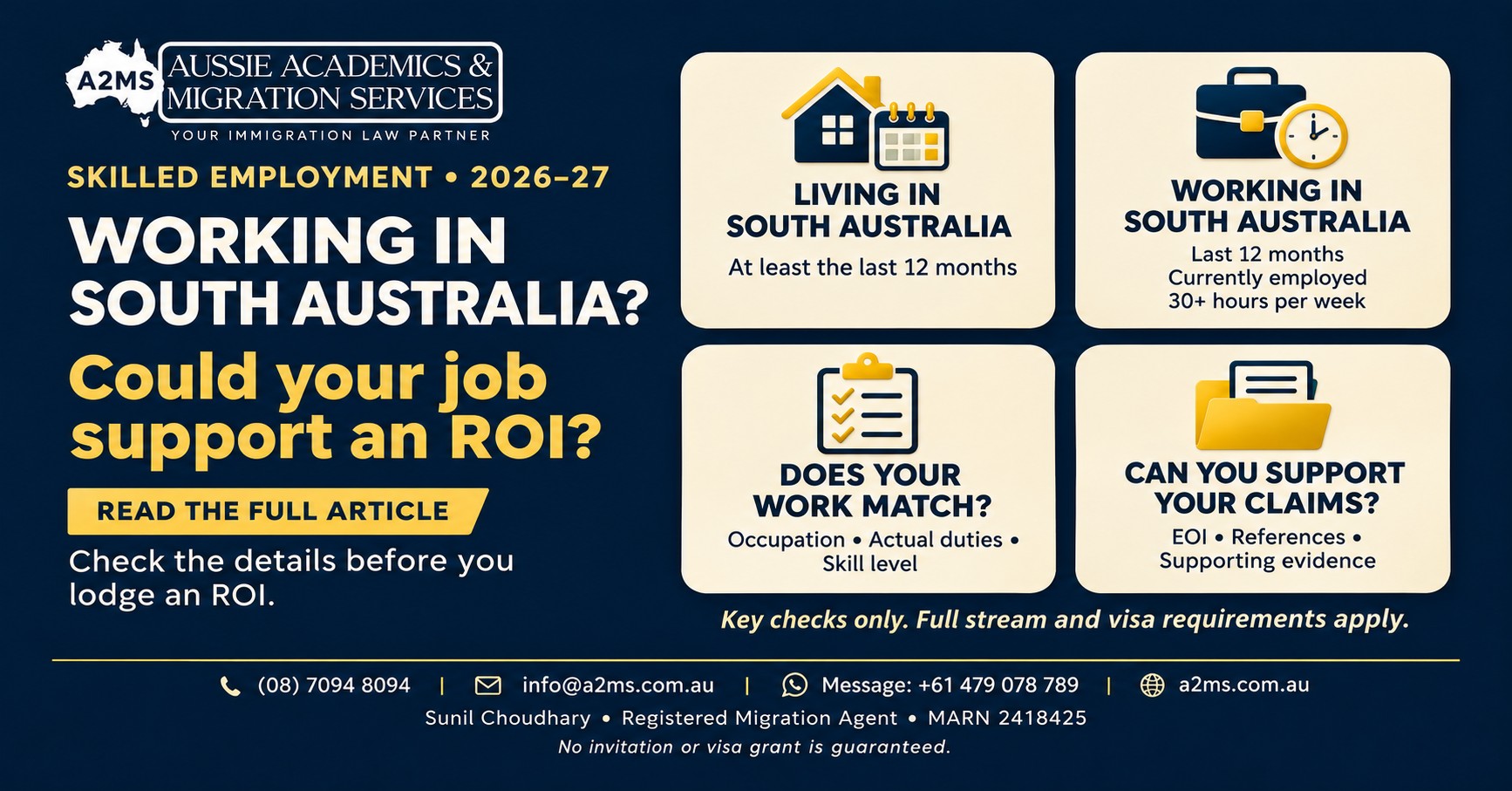
A practical guide to checking whether your work history fits the Skilled Employment in South Australia stream.
You’ve built a life in South Australia and you’re working here. With ROIs now open, it is natural to ask: could the job you already do support your next migration step?
Start with your employment history. Your duties, weekly hours and work dates can matter just as much as the title on your contract. This guide helps you identify what to check before you lodge.
Who this is for: people considering the Skilled Employment in SA stream. Graduate and outer-regional pathways have separate rules. See our SA nomination overview to compare pathways.
Start here
Your first three employment checks
For the Skilled Employment in South Australia stream, check these periods separately:
These checks are only part of eligibility. Your occupation, duties, skill level, EOI, age, English, skills assessment and points still matter.
Does the work I do meet the requirements?
Start with four facts: your nominated occupation, actual duties, workplace and employment dates. Then check the remaining requirements below, alongside the three employment checks above.
For Skilled Employment in SA, check these published requirements:
- Work related to the nominated occupation and at the same skill level—generally the same ANZSCO Sub Major Group, identified by its first two digits.
- An occupation available for this stream on SA’s occupation list.
- A current SkillSelect EOI with SA as first preferred state or territory.
- Under 45 when nomination is approved; a valid positive skills assessment; at least Competent English; and at least 65 points including nomination points.
This is a starting checklist. Check the current occupation entry and your circumstances before lodging.
Would my employer’s reference tell the same story as my EOI?
A useful preparation exercise is to compare three things side by side: your nominated occupation, the duties you actually perform and the duties your employer can verify. Where these tell different stories, resolve the difference before making a claim.
Changed jobs, combined hours or started work recently?
These illustrative situations explain the checks to make; they are not individual eligibility assessments.
Scenario 01 · Different timelines
“I’ve lived in Adelaide for 15 months, but started this job eight months ago.”
Put your SA arrival date and your qualifying work start date on separate timelines. Months spent living here do not fill a shortfall in the required employment period.
Your next check: identify which work periods you can actually rely on under this stream. Graduate and outer-regional pathways have separate rules.
Scenario 02 · Changing employers
“I changed jobs and had a three-week gap. Does that rule me out?”
SA’s FAQs say a gap of no more than one month may be considered case by case. Neither an automatic refusal nor an automatic concession should be assumed.
Your next check: record both employment periods, the gap, duties and hours, and obtain supporting references.
Scenario 03 · Two jobs
“I work 18 hours in one role and 14 in another. Can I combine them?”
SA permits combining paid work across employers to meet hours, subject to the required skill level. A total of 32 hours alone does not establish eligibility.
Your next check: examine both roles, their duties and employment periods before combining the hours.
SA’s official FAQs also say pro-rata hours over a longer period are not accepted. For interstate employers, check the requirement for a physical presence in SA; an SA home address alone is insufficient.
What will the ROI ask me to explain?
The ROI is more than three document uploads. Have your EOI details, intended visa subclass, current visa information, English level, qualifications and employment history ready. For each relevant job, check the employer’s legal and trading names, ABN, physical work location, employment type, dates, pay, weekly hours and actual duties. Complete partner details where the form asks for them.
Prepare your ROI pathway statement—maximum 500 words
The ROI form reviewed for this guide asks for a statement about the skills and experience you bring to South Australia and how your experience relates to your chosen pathway, with a maximum of 500 words—not a requirement to write exactly 500 words. Follow the wording and limit shown in your live application.
- Your relevant background: identify your nominated occupation, relevant qualifications and supported experience.
- Your current work: explain your actual responsibilities, work setting and relevant skills using concrete facts.
- Your chosen pathway: connect that experience to the stream you selected and your employment in South Australia.
- Check the evidence: reconcile dates, duties and experience with your CV, EOI and references. Remove repetition and unsupported claims.
You do not need to use the entire allowance. A clear, accurate explanation is more useful than a long promotional statement. The statement does not replace eligibility requirements or supporting documents.
ROI form preparation: details to have ready
- Identity and contact: passport details, date of birth, residential address, applicant email, telephone and preferred contact method.
- Visa: current subclass, grant and expiry information. Resolve any difference between the current visa and an earlier substantive visa.
- EOI and pathway: EOI ID, points including nomination points for the relevant subclass, the visa subclass you wish to be considered for, nominated occupation and selected stream.
- English and family: the English level supported by your records, whether a partner is migrating and the partner’s occupation where asked.
- Experience: total time working in your nominated or closely related occupation while living in South Australia, supported by a complete timeline—not simply time since arrival.
- Education: qualification name and level, institution, country, state, campus, commencement and completion dates.
- Each employment entry: occupation, job title, employer trading and legal names, ABN, website, physical work location and postcode, relationship to the nominated occupation, employment type, pay in the unit requested, average weekly hours, duties, start/end dates and whether the job is current.
- Statement, consent and submission: prepare the pathway statement, answer employer-contact consent questions, review the declarations and terms, and attach only the documents currently requested.
These are preparation categories from the form reviewed, not a reproduction of a client application. Portal questions can change.
What evidence should I prepare—and when?
Stage 01
For the ROI
- Visa approval letter
- Current CV
- Current employment reference
The reference should cover duties, hours, pay, dates and location, and be signed and dated on company letterhead.
Stage 02
For nomination, if invited
The wider checklist covers supporting evidence such as:
- Payslips and superannuation
- Residence evidence
- Skills, English and qualifications
Use SA’s current document checklist for your stage and any specific request. Preparing evidence early does not mean uploading every document with an ROI.
Open the practical nomination evidence checklist
- Employer references: check duties, pay, hours, dates and location, plus the responsible manager or HR contact’s name, position, email and phone. Explain changes in role or hours. Additional workplace confirmation may be needed for subcontracted placements.
- Payslips: put the required period in date order, grouped into one PDF per employer.
- Several employers at once: use SA’s work-experience proforma where required. Map overlapping dates and qualifying hours clearly; do not count an overlapping period twice as extra elapsed experience.
- Superannuation: include transaction records covering the relevant period, rather than relying only on an account balance.
- Residence: prepare bank statements showing salary and everyday transactions, and lease or room-lease records with rental-payment evidence. SA does not accept a driver’s licence or mobile-phone statement as residence proof.
- Other evidence: follow the current checklist for identity, qualifications, English, skills assessment and any circumstances-specific documents. Keep licensing or registration details accurate where relevant.
Upload only what the current checklist or assessing team requests. Use clear filenames and check for missing periods or accidental duplicates.
If I meet the requirements, will I receive an invitation?
For this onshore stream, SA says higher EOI points are not a selection factor beyond the minimum threshold. It considers English, skilled experience, qualifications, salary and employer assessment together. Invitations are competitive; eligibility does not guarantee selection. See the published selection guidance.
The November announcement identifies priority sectors including building and construction, defence, education, engineering, health and manufacturing. High-ranking candidates outside priority sectors may also be considered. Priority status is not a substitute for an eligible occupation and qualifying employment.
What should I do before I lodge?
- Build a dated timeline: residence, employment, role changes, hours and any gaps.
- Check the occupation and stream: use the current occupation list and stream page together.
- Reconcile your records: make sure the CV, EOI and employer reference describe the same work history accurately.
- Follow the application sequence: prepare the EOI and then the onshore ROI through SA’s Apply Portal. If invited, complete the separate nomination application.
SA’s How to Apply guide states that ROI applications have no government fee. A “Not Invited” decision prevents a new ROI application for three months. Lodging should therefore follow an informed eligibility check, rather than a rushed response to an opening announcement.
If invited, what else does the nomination form ask?
Open the nomination application preparation checklist
- Visa history: current visa information, bridging visa subclass and previous substantive visa where applicable, pending visa applications, and any refusal or cancellation history.
- Family: partner identity, contact, passport and visa details, and dependants’ details where requested.
- EOI claims: verify the points breakdown, including skilled-partner or partner-English claims, community-language points and Professional Year claims where relevant. A state nomination assessment is not confirmation that every Home Affairs points claim is correct.
- Occupation and English: check licensing/registration questions, research into job opportunities, the current occupation-list requirements, and English test name, date and supported level.
- Education and employment: reconcile the full education and work histories. Identify self-employment or subcontracting where asked, and distinguish legal employer identity from the physical workplace.
- Evidence: follow the current nomination checklist for identity, skills, English, qualifications, employment and residence. Some circumstances require additional evidence; one example’s attachment list is not a universal checklist.
- Declarations: read the settlement intentions and obligations, financial preparedness, contact-update and survey commitments, consent and accuracy declarations. Do not treat preselected or unfinished draft answers as confirmation.
For self-employment or subcontracting, check the additional invoice, tax and proforma evidence in the official document checklist. Confirm that your circumstances satisfy the relevant stream separately.
Do my records tell one consistent story?
Before submitting, compare your EOI, ROI, CV, employer references and nomination application. A genuine change can be explained; an unexplained mismatch can make your claims harder to assess.
- Dates and hours: reconcile work periods, gaps, overlapping jobs and the total experience claimed.
- Occupation and pay: check duties, employer identity, physical workplace, salary and whether a pay figure is annual, weekly or hourly.
- EOI claims: verify the relevant subclass, points breakdown, English and partner claims against the evidence and current EOI version. Do not assume the same points total applies to both 190 and 491.
- Validity and completeness: check document expiry dates, required fields, attachments and the applicant’s final declarations before submission.
Your circumstances deserve a closer look
Unsure whether your work history fits?
Bring your occupation, work dates, weekly hours and current visa details to a discussion with A2MS. We can assess the relevant requirements, identify evidence gaps and explain your available options.
If available, have your CV, employment reference, skills assessment, English evidence and EOI ready. Your actual records help us focus the discussion on your situation.
Founder & Director — A2MS
Principal Registered Migration Agent | MARN 2418425
G01, 450 Pulteney Street, Adelaide SA 5000
(08) 7094 8094 · [email protected]
WhatsApp: +61 479 078 789
Further reading: Subclass 190 guide · Subclass 491 guide · SA nomination overview
General information reviewed on 23 November 2026, not individual migration advice. Requirements and occupation availability can change. State nomination and visa grant are separate decisions. Check current official guidance and your circumstances before acting.

One Comment
South Australia Skilled Migration 2026–27: Who Can Apply? | A2MS
[…] practical guide: Working in South Australia? Could your job support an SA ROI? Check employment scenarios, ROI preparation and nomination […]